

The data center industry is facing a critical labor shortage as demand for digital infrastructure surges. With global staffing needs projected to reach 2.5 million by 2025, companies are struggling to find and retain skilled workers, leading to higher costs and missed deadlines. Here’s how the industry is tackling the issue:
- Training Programs: Internal training, partnerships with schools, and online courses are helping workers gain essential skills in technical operations, cloud computing, and cybersecurity.
- Broadening Recruitment: Companies are hiring from related industries (e.g., construction, manufacturing), promoting diversity, and targeting veterans and career changers.
- Technology Solutions: Automation, remote management tools, and predictive analytics are reducing labor demands and improving efficiency.
- Collaboration: Shared apprenticeship programs, standardized training, and government partnerships aim to expand the talent pool and lower training costs.
The industry is focusing on education, technology, and collaboration to address workforce challenges and ensure sustainable growth.
Workforce Training for Data Centers
Training Workers to Meet Data Center Needs
Internal Training for Skill Development
With only 15% of applicants meeting basic job qualifications and roles taking up to 60 days to fill [3], data center operators are turning to internal training programs. These programs focus on four main areas:
- Technical operations: Ensuring workers can maintain infrastructure effectively.
- Cloud computing: Preparing teams to manage modern infrastructure.
- Cybersecurity: Strengthening protection for facilities.
- Problem-solving: Enhancing response to emergencies and improving efficiency.
Partnering with Schools to Build Talent Pipelines
Educational partnerships are helping to fill the 10% vacancy rate in existing data centers [3]. One example is CyrusOne's Digital Futures Programme, which promotes data center careers to underrepresented communities [1].
Steve Hayward, Senior Director of European Operations at CyrusOne, highlights the importance of this approach:
"The industry has a vital role to play in engaging students and raising awareness of all the exciting career paths in STEM, from creating mentorship programs to supporting women in a male-dominated field." [1]
By collaborating with technical schools, companies are creating apprenticeships, internships, and specialized training programs to prepare students for careers in the field.
Online Learning to Bridge the Skills Gap
Online platforms offer flexible training options with certifications recognized across the industry. These courses allow workers to gain new skills while staying in their current jobs. They are also an effective way to train employees in multiple locations and focus on specific skill areas.
Steve Hayward stresses the importance of transferable skills in this context:
"It is essential that the data center industry identifies the key generic skills required for exceptional engineers, such as being solutions-oriented and having strong problem identification abilities. These skillsets are not unique to our industry and can be found in professionals from various sectors." [1]
While internal training addresses existing gaps, expanding the talent pool requires exploring non-traditional hiring avenues.
Broadening the Workforce for Data Centers
Hiring Talent from Related Industries
Data centers are tapping into talent from fields like construction and maintenance. For instance, TBL Mission Critical brings in electricians and HVAC technicians, whose expertise in power systems and cooling directly supports data center operations [4]. This hiring strategy focuses on shared skill sets: manufacturing professionals bring a deep understanding of complex systems and safety standards, while energy sector workers contribute valuable knowledge of power distribution and energy efficiency.
Efforts to expand recruitment also include reaching out to underrepresented groups to widen the talent pool.
Encouraging Diversity in Hiring
With many applicants not meeting qualification standards [3], data centers are adopting inclusive hiring strategies to address this challenge. One example is CyrusOne's Digital Futures Programme, which uses mentorship, STEM outreach, and career development initiatives to attract underrepresented groups to the industry [1].
In addition to diversity efforts, looking beyond traditional talent sources is helping bridge workforce gaps.
Reaching Out to Non-Traditional Workers
Veterans bring technical skills and a disciplined approach that make them ideal for roles requiring precision and reliability [4]. Remote work options are also opening doors for non-traditional hires in monitoring and management positions [2]. To aid career changers, data centers are introducing specialized training programs that build on existing skills while teaching industry-specific knowledge.
Platforms like Data Center Directory are playing a key role by connecting these candidates with high-paying jobs and offering detailed career resources.
sbb-itb-d22037a
Using Technology to Address Labor Shortages
Automating Data Center Operations
AI-powered cooling systems, like those used by Google, have shown up to a 30% boost in cooling efficiency while cutting down on manual tasks. These systems constantly monitor and adjust environmental settings, allowing data centers to run with fewer on-site staff.
Beyond cooling, AI tools handle routine maintenance and troubleshooting, easing the burden on employees. With automation taking over repetitive tasks, remote management tools make operations even smoother.
Managing Data Centers Remotely
Remote management tools let operators oversee several facilities from a single location, reducing the need for on-site teams. Here's how these tools are reshaping the industry:
| Remote Management Solution | Impact on Labor Requirements |
|---|---|
| Centralized monitoring systems | Cuts on-site staffing needs by up to 40% |
| Virtual facility tours | Removes the need for physical presence during inspections |
| Remote troubleshooting tools | Allows quick issue resolution without travel |
Optimizing Resources with Predictive Tools
Predictive analytics helps prevent unplanned downtime by up to 70%, enabling smaller teams to manage operations effectively. Data centers are also turning to offsite integration and pre-populated rack systems to simplify workflows.
To tackle deployment challenges, companies are rolling out new products. For example:
"The industry is seeing the development of smaller, multi-fiber connectors and multi-gang connectors with over 100 fibers per single connection, significantly reducing the complexity of field operations" [3].
These tools not only address labor shortages but also help ensure smoother, more reliable operations. By embracing these advancements, the industry is building a more resilient future.
Collaborating to Solve Workforce Challenges
Developing Training Standards
Data centers are working together to establish shared training standards that make it easier for employees to move between companies without sacrificing service quality. These standards emphasize technical skills, safety procedures, and hands-on learning. Depending on the scope, these programs can take anywhere from 1 to 8 months to roll out.
Shared Apprenticeship Programs
Companies are teaming up to create shared apprenticeship programs, which aim to expand the talent pool while lowering training costs. By pooling resources, these initiatives help build a stronger and more prepared workforce.
However, while these partnerships are important, government involvement and policy adjustments could further enhance the impact of these efforts.
Pushing for Government Collaboration
The data center sector is actively working with government agencies to improve workforce development. These collaborations focus on securing funding for training programs, advocating for tax incentives, and easing immigration policies to attract global talent.
These partnerships with the government complement the industry's internal efforts, creating a more unified strategy to tackle workforce issues. Platforms like Data Center Directory are being used to connect skilled professionals with job opportunities, while also fostering stronger ties with policymakers.
Additionally, industry leaders are urging for more investment in STEM education. Early exposure to technical fields is seen as a key step in building a steady pipeline of skilled workers. Companies are also addressing employee satisfaction by improving compensation packages, as surveys show that nearly half (48%) of workers are unhappy with their current benefits [1].
Conclusion: Solving the Labor Shortage in Data Centers
Key Takeaways
The data center industry faces a growing demand for skilled workers, with global staffing needs expected to rise from 2.0 million to 2.3 million by 2025. Compounding this challenge is an aging workforce nearing retirement. To tackle these issues, organizations are exploring multiple approaches.
Companies are focusing on internal training programs, technology upgrades, and collaborative initiatives. A great example is CNet Training's Global Data Centre & Network Infrastructure Education Framework, which offers structured learning paths to help employees advance their careers.
Standardized training and apprenticeship programs have also been effective in closing skills gaps and improving mobility within the workforce. The 2024 Data Center Salary Survey highlights that while nearly half (48%) of workers are unhappy with their benefits, businesses that emphasize competitive pay and career growth opportunities tend to retain employees more effectively.
Platforms like Data Center Directory are also stepping up to connect skilled professionals with job opportunities, further addressing the talent shortage.
The Role of Platforms Like Data Center Directory
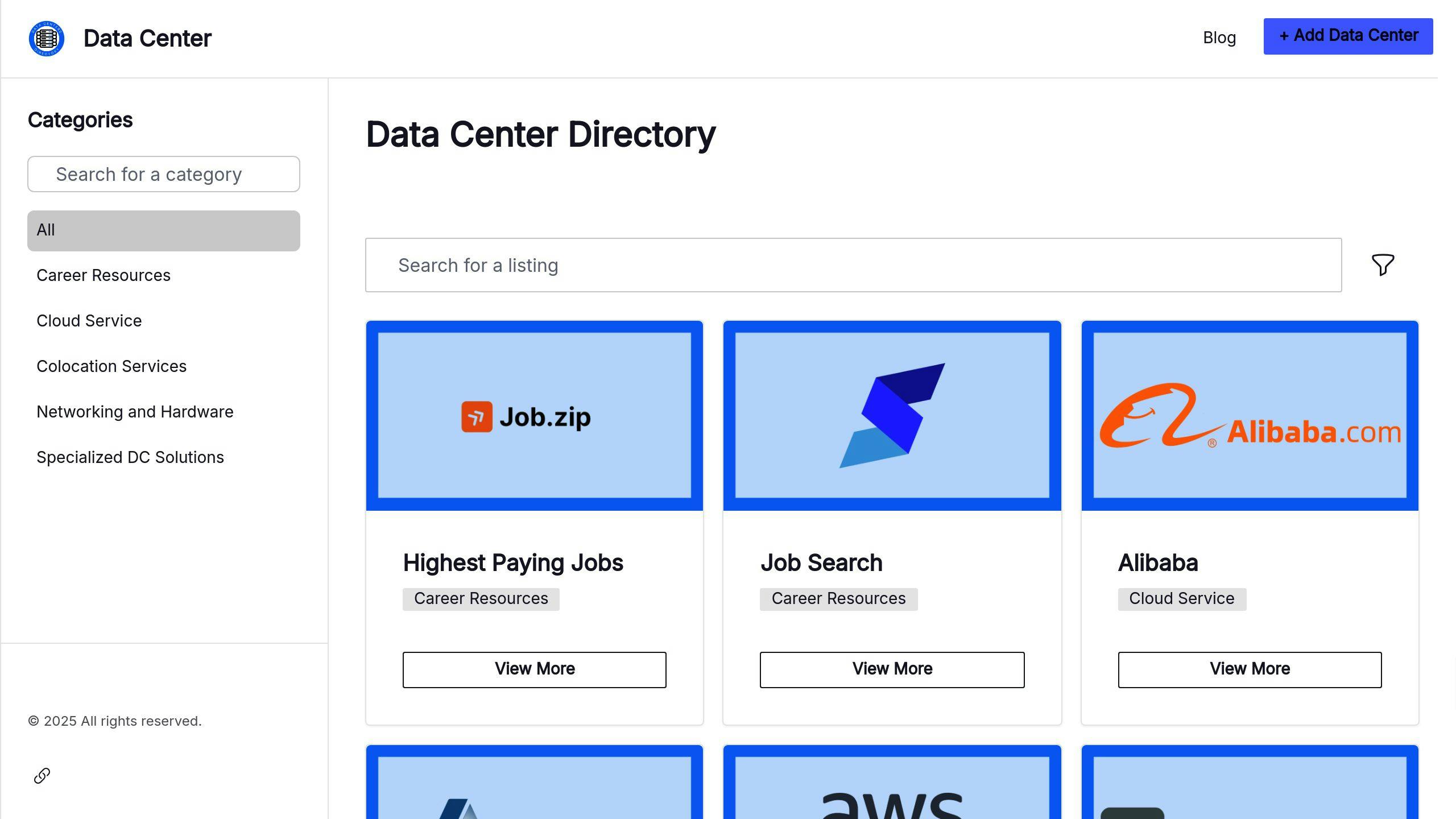
Platforms such as Data Center Directory complement other recruitment and training efforts by offering essential tools to support workforce development. With a wide range of services, from cloud computing to niche solutions, these platforms help both employers and job seekers navigate the industry.
Here’s how platforms like these make an impact:
| Initiative Type | Benefit |
|---|---|
| Career Resources | Maps out job roles and career progression opportunities |
| Industry Networking | Links professionals with top employers and mentorship programs |
| Skills Development | Provides training courses and certifications to enhance expertise |
| Job Matching | Connects qualified candidates with the right job opportunities |